
Key takeaways (NC vs SC near Charlotte)
There’s no “wrong side”—only priorities. The NC/SC border suburbs can feel very different even when they’re only a few miles apart.
NC usually wins on convenience + variety. More suburb choices, more established shopping/dining clusters, and easier access to Charlotte’s biggest employment hubs and entertainment districts.
SC often wins on “more house for the money.” Many buyers find newer neighborhoods and a stronger value-per-square-foot just south of the border (especially York County areas like Fort Mill/Clover/Lake Wylie).
Commute reality check: I-77 is the deciding factor.
North of Charlotte (NC): I-77 has express toll lanes—you can sometimes buy back time.
South of Charlotte (SC): no toll lanes—traffic is traffic.
Walkability favors NC, but Fort Mill is catching up. NC has more established walkable districts (South End, Ballantyne nodes, historic downtowns), while SC has strong pockets like Baxter/Kingsley/DT Fort Mill.
Lake life is strong on both sides—but the “lake vibe” differs.
Lake Norman (NC): biggest and most built up; often busier + higher prices.
Lake Wylie (NC/SC): more balanced value; commute bottlenecks matter depending on where you live.
Mountain Island Lake (NC): smaller, quieter.
Schools are a major SC draw—but NC has standout districts too. Many families look to SC border districts (notably Fort Mill), while NC shines in suburbs like Union County and select north/NE areas.
Everyday laws feel different (and people notice quickly):
Liquor: NC uses ABC store system; SC is privately sold.
Happy hour: structured differently; NC generally doesn’t allow traditional happy-hour discount windows.
Vehicle inspections: NC requires annual inspections; SC does not have a statewide annual program like NC.
Fireworks: NC is stricter; SC generally allows broader consumer fireworks (with restrictions on certain items).
Taxes can swing the decision more than people expect.
Income tax: NC has a flat rate (4.25% for 2025; scheduled 3.99% after 2025).
SC: progressive with a top marginal rate at 6% for 2025.
Capital gains: SC offers a 44% deduction on long-term gains; NC taxes gains like regular income.
Gas: NC’s gas tax is higher than SC’s, often making SC cheaper at the pump.
Retirees often lean SC for perks, but both states can work. SC’s Homestead Exemption and senior programs can be meaningful for qualifying homeowners.
Politics are more local than “NC vs SC.” In the Charlotte region, county/community culture often matters more than the state line for day-to-day life.
If you’re thinking about moving to the Charlotte area, you’ve probably asked the same question we hear every week: Should we buy on the North Carolina side or the South Carolina side?
Because Charlotte is a fast-growing metro that hugs the state line, you can find amazing suburbs in both states—often just minutes apart, but with meaningful differences in taxes, cost of living, schools, laws, and lifestyle.
Below is a practical, “real-life” breakdown of NC vs SC living around Charlotte, organized by the exact topics relocation buyers care about most.
Quick answer: who should choose NC vs SC?
Choose North Carolina (NC) if you want:
More neighborhood variety + more “in-town” lifestyle options
Easier access to Charlotte’s core job hubs and amenities
More established walkable districts and shopping clusters
More lake options (especially around Lake Norman)
Choose South Carolina (SC) if you want:
More house for the money (often)
Highly rated school districts near the border (especially Fort Mill area)
Lower gas taxes and often lower everyday costs
Retirement-friendly perks (property tax + tuition programs)
(We’ll unpack the “why” behind each one below.)
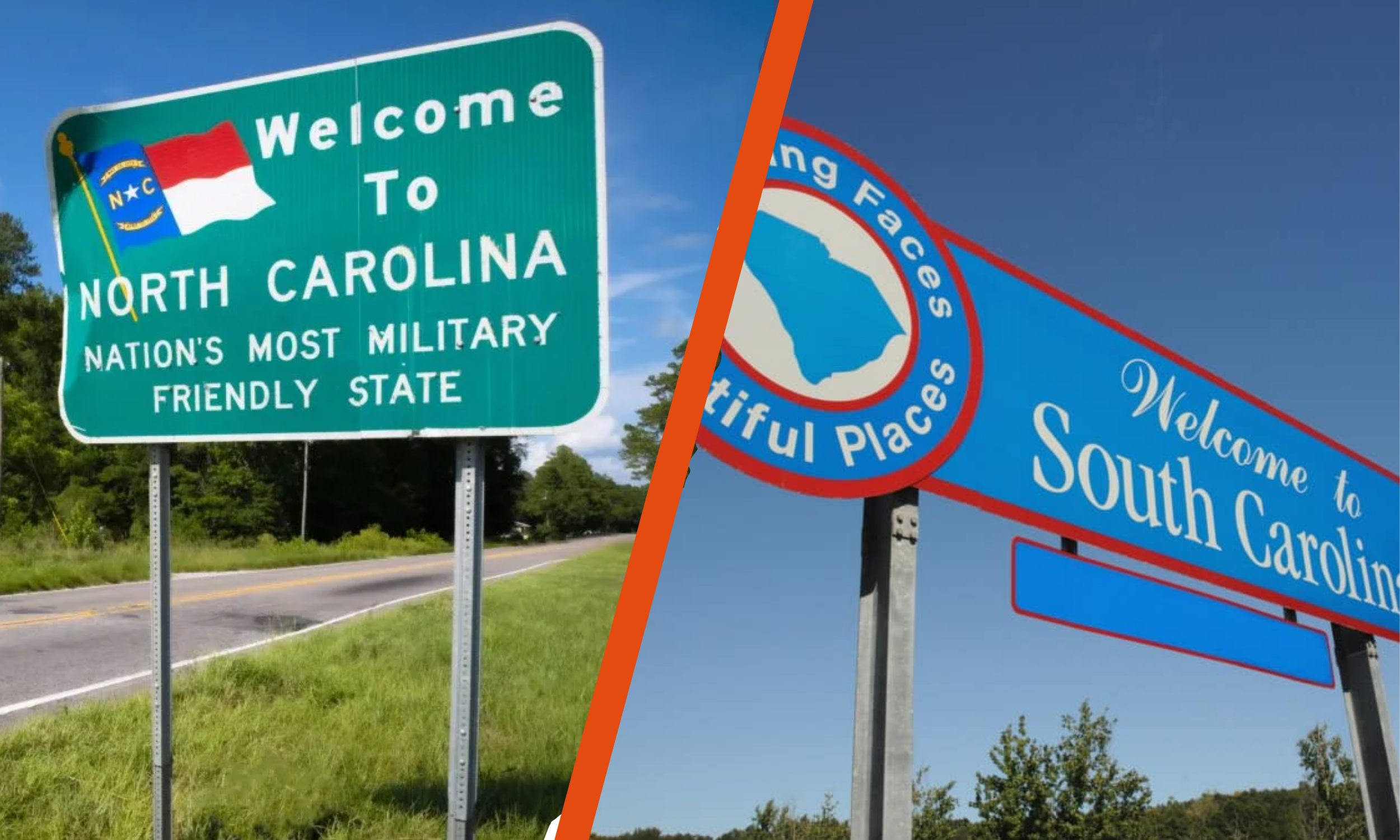
Communities: what suburbs are on each side?
North Carolina suburbs (the majority of Charlotte’s metro)
On the NC side, you’ll find the broadest spread of Charlotte suburbs—everything from luxury, top-school enclaves to lake towns and historic main streets:
South/SE: Weddington, Waxhaw, Matthews, Marvin
NE: Concord (and surrounding areas)
North: Huntersville, Cornelius, Davidson, Mooresville, Denver
West: Belmont, Gastonia (and beyond)
Why people love NC communities: more options, more established development patterns, and generally quicker access to Charlotte’s largest shopping + entertainment zones.
South Carolina border suburbs
South Carolina’s Charlotte suburbs cluster along the border and have grown rapidly because they’re close to Charlotte while offering different pricing and policies:
Clover / Lake Wylie
Tega Cay / Fort Mill
Rock Hill (farther south)
Indian Land / Lancaster (SE)
Why people love SC communities: newer neighborhoods, strong school reputations near the border, and (often) a better “space-for-the-price” feeling.

Jobs + income: it’s more “suburb desirability” than state
Charlotte works like a hub-and-spoke: the city is the hub, suburbs are the spokes.
Uptown Charlotte remains a major center for banking, corporate, and professional services.
South Charlotte/Ballantyne has big corporate campuses.
University City is a large healthcare + research cluster.
Just over the border, Fort Mill / Indian Land has seen major growth with headquarters and large operations.
For most households, the difference is less “NC vs SC jobs” and more:
Where is your office, and how painful will your commute be?

Walkability + amenities: NC usually wins (but SC is catching up)
Walkable districts you’ll hear about on the NC side
NC tends to offer more established walkable “nodes,” including:
South End (Charlotte)
The Bowl at Ballantyne (Charlotte area)
Historic downtowns like Davidson, Waxhaw, and Belmont
Walkable districts on the SC side
SC has strong pockets too, especially in Fort Mill:
Baxter
Kingsley
Downtown Fort Mill
Downtown Rock Hill
Overall, SC often feels a bit more suburban/rural (for now), which can mean fewer shopping clusters—but if you’re near the border, you’re still a short drive to major NC amenities.

Lake life: Lake Norman vs Lake Wylie vs Mountain Island
If “weekends on the water” are part of your plan, Charlotte is a great place to compare lake lifestyles, not just states.
NC lakes near Charlotte
Lake Norman (north): the biggest and most developed lake market—more marinas, more restaurants, usually higher price tags.
Mountain Island Lake (NW): smaller, quieter, and known for being cleaner due to its role tied to local water supply.
Lake Wylie (shared by both states)
Lake Wylie stretches across NC + SC, which means you can choose communities on either side:
NC side: Steele Creek / Charlotte edge, Belmont
SC side: Lake Wylie, Clover, Tega Cay, Fort Mill
Typical vibe differences:
Lake Norman often feels busier and pricier due to heavy development, while Lake Wylie can feel more “balanced” for value and access—though commute bottlenecks matter a lot depending on where you are.

Traffic + commuting: the I-77 reality (toll north, no toll south)
Traffic is a fact of life in a booming metro. Where you live matters more than which state—except for one big I-77 detail:
I-77 North (NC): Express lanes with tolls
The I-77 Express Lanes run between Charlotte and Mooresville and use tolling/dynamic pricing. NC Quick Pass+1
This can be a time-saver if you’re commuting from Huntersville/Cornelius/Davidson/Mooresville.
It can also become a budget line-item, depending on your driving patterns.
I-77 South (SC): no toll lanes
Southbound I-77 into Charlotte does not have the same toll lane setup, so you’re typically dealing with standard congestion without a paid “escape hatch.”
Bottom line:
North commuters may buy time using toll lanes.
South commuters may save money but can’t “pay-to-play” their way out of traffic.
Schools: why so many families look at SC (and where NC shines)
School quality is a major reason buyers choose one side of the border over the other—and it’s also where people get tripped up, because “good schools” can mean different things depending on what you value (test scores, programs, safety, sports, etc.).
A major relocation trend: many families move out of Mecklenburg County for schools (even if they still want easy Charlotte access).
Fort Mill’s school reputation is often cited as a top draw for SC-side buyers (rankings vary year to year depending on the source).
NC has strong districts too—especially in Union County and several north/NE suburbs.
Best approach: use schools to narrow your search area, then compare neighborhoods inside that zone.

Laws that surprise new residents: fireworks, liquor, happy hour, inspections
These “daily life” rules can genuinely affect your routine.
Fireworks
NC is stricter—many aerial fireworks are illegal. cityofws.org+1
SC generally allows broader consumer fireworks, though there are still exceptions (for example, SC law restricts certain bottle rockets). scstatehouse.gov
Liquor buying
NC: spirituous liquor is sold through ABC systems/stores (regulated structure). abc.nc.gov
SC: liquor sales are licensed and handled through private businesses (not the same ABC store model). dor.sc.gov
Happy hour
NC: happy hour drink discounting is not allowed the way many states do it—drink specials must generally run for a full business day. abc.nc.gov
SC: drink specials are allowed within specific restrictions (commonly cited as limited windows like 4–8 pm, with pricing rules). ServSafe
Vehicle inspections
NC: annual safety inspection required; some counties also require emissions. ncdot.gov
SC: no statewide annual vehicle safety inspection program like NC’s (SC ended its program years ago).


Cost of living: groceries, gas, insurance, and the housing difference
Day-to-day costs can be similar, but a few categories commonly lean one way:
Gas tax
North Carolina’s motor fuels tax has been around 40.3 cents/gal for 2025 and is set at 41.0 cents/gal for 2026 per NC DOR notices.
South Carolina’s motor fuel user fee is about $0.28/gal (plus small additional fees).
That gap often shows up at the pump.
Housing
Housing is frequently the biggest “swing factor.” Many buyers feel their budget stretches farther on the SC side close to the border—especially when comparing newer construction neighborhoods.
(Exact pricing changes fast, so always check current listings for the specific neighborhood, not just county averages.)

Taxes: income, sales, capital gains, and property taxes (what matters most)
Income tax
NC: flat individual income tax 4.25% for 2025, and 3.99% after 2025 per NC Department of Revenue.
SC: progressive brackets; SC Department of Revenue notes the top marginal rate reduced to 6% for tax year 2025.
In plain English: higher earners often see NC’s flat rate as simpler and sometimes lower, while SC’s structure can vary more by income.
Sales tax (Mecklenburg County update)
Mecklenburg County voters approved a 1% local sales tax referendum for transportation investment (timing/implementation depends on the program rollout). Charlotte City Government
Capital gains
NC: taxes capital gains as income at the flat rate (no special exclusion).
SC: allows a 44% deduction of recognized net capital gains held longer than one year.
If you’re a high-income household with investments, this can be a meaningful difference (talk with a tax pro for your situation).
Property tax + senior relief
SC is well known for its Homestead Exemption: it exempts taxes on the first $50,000 of fair market value of a legal residence for qualifying homeowners (including age 65+).
NC has senior/disabled property tax relief programs too, typically excluding the greater of $25,000 or 50% of the taxable value for qualifying owners (county-administered rules apply).
Homeschooling: NC vs SC oversight differences
If homeschooling is part of your plan, the systems are noticeably different.
NC: you file a Notice of Intent with the Division of Non-Public Education, and standardized testing is part of compliance expectations. NC DOA+1
SC: families can homeschool under different “options” (district-linked or association-based approaches). ed.sc.gov
Because the details vary by option (and can change), it’s smart to confirm requirements directly through the state education resources when you’re ready to set up.

Retirement: which side is better for retirees?
Both Carolinas are popular for retirement, and both have perks. A few SC-specific advantages that often stand out:
Homestead Exemption for eligible seniors (property tax relief) dor.sc.gov
Age 65+ deductions related to retirement income (rules/limits apply) dor.sc.gov
Tuition-free programs for SC residents age 60+ at public universities (space-available; fees/books may apply). winthrop.edu+1
Jury service excuse options in SC for age 65+ (opt-out style). sccourts.org
NC also allows older residents to request jury duty excusal starting at age 72+
Politics: more local than “NC blue / SC red”
People love to generalize this as “NC is blue, SC is red,” but Charlotte-area politics often feel county-by-county and community-by-community more than state line.
In practice, most relocating families tell us their daily quality of life is shaped more by:
commute
schools
neighborhood feel
home style and lot size
taxes and costs
…than by the headline political label of the state.
Thinking about moving to the Charlotte area but still torn between North Carolina and South Carolina? That’s exactly where we come in.
👉 Whether you’re relocating from out of state or already living in Charlotte, our team helps buyers compare NC vs SC neighborhoods side by side, looking at commute times, schools, taxes, home values, and lifestyle so you can make the best decision for your situation, not just what looks good on paper.
📍 We live here.
📊 We track the market daily.
🏡 We help families make this move every single week.
Call, text, or email us today to get:
A personalized NC vs SC comparison based on your budget and commute
Neighborhood recommendations you won’t find on Zillow
Real advice on schools, taxes, and resale value
Access to homes before they hit the market
👉 Thinking about making a move? Reach out now. We’d love to help you find the right side of the border and the right place to call home.
Let’s Connect Today!

Phone:
704-200-9833

Email:
info@thefinigangroup.com

Visit Us:
3440 Toringdon Way, ste 205
Charlotte NC 28277


Donec id justo non metus auctor commodo ut quis enim. Mauris fringilla dolor vel condimentum imperdiet.